
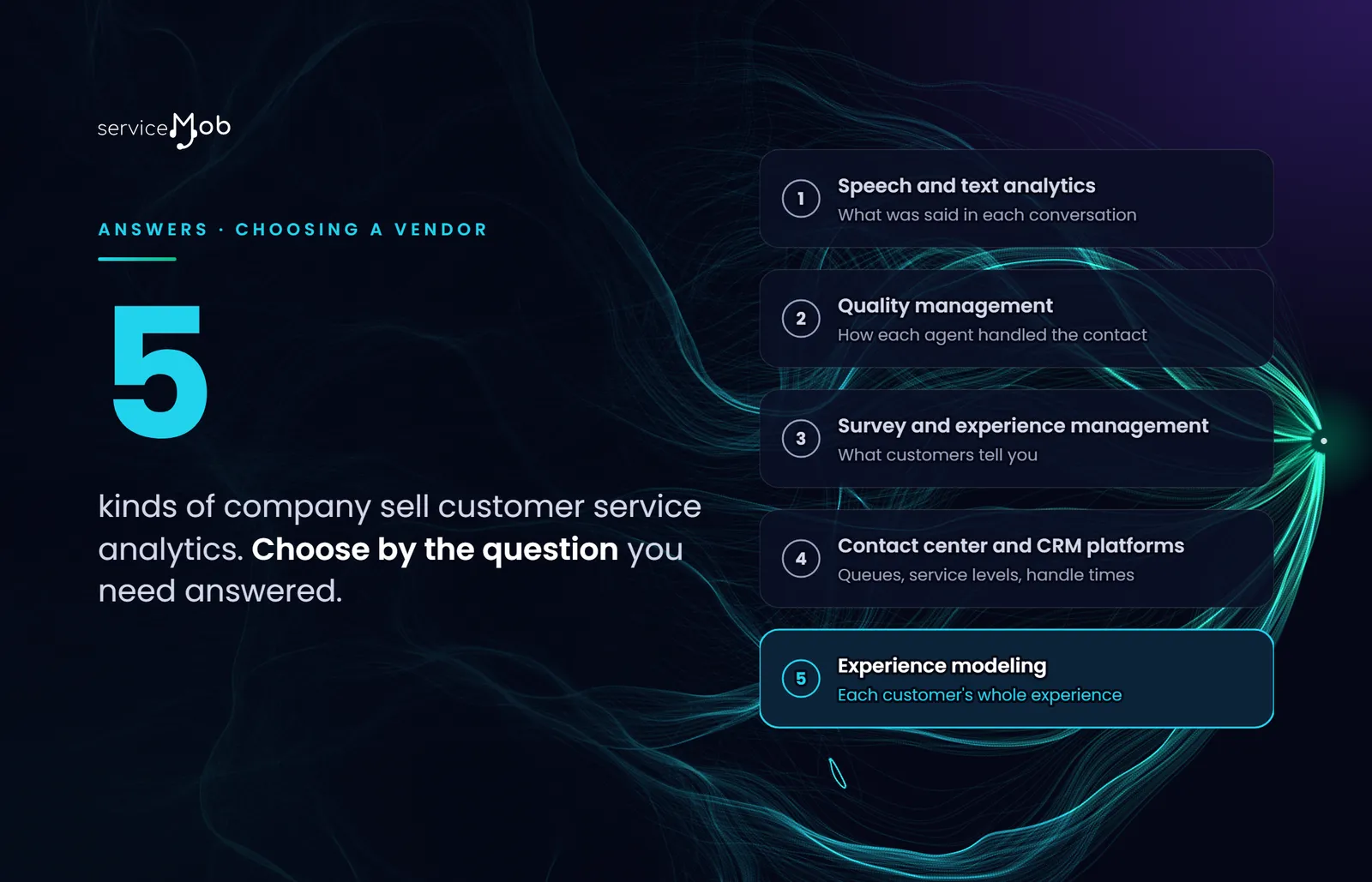
Most vendor lists for this question mix five kinds of customer service analytics product that answer five different questions. Below is how the categories split, a few companies whose own websites place them in each one, and how to tell which category your problem needs. I run serviceMob, which sits in the last category, so I’ll also say plainly when we’re the wrong buy.
Who sells speech and text analytics?
CallMiner and Verint are two speech and text analytics vendors. Products in this category transcribe and mine conversations (calls, chats, emails, messages) for topics, sentiment, reasons for contact and compliance phrases. CallMiner describes itself as an AI-powered conversation intelligence platform for omnichannel customer interactions, and Verint sells a product called Verint Speech Analytics.
Buy from this category when the question lives inside the conversation: what customers say, how agents respond, whether a required disclosure was read out. The unit of analysis is the interaction. If you also need to know that a call, a chat two days earlier and a refund a week later were one customer’s one problem, ask the vendor to show you how it links them.
Who sells quality management?
Quality management is sold by NiCE, under the product name NiCE Quality Management, and by Verint, which names it among the workflows its platform automates. The category scores agent interactions against a standard and feeds coaching.
This category fits when the question is how individual agents handle contacts and you need evidence for coaching and compliance. Remember what a QA score grades: the conversation. A call can score perfectly and still produce a callback three days later, because the outcome happens after the score is written.
Who sells survey and experience management?
Qualtrics and Medallia sell survey and experience management, and both describe their category as experience management on their own sites. These platforms collect what customers tell you (CSAT, NPS, effort scores, open-text comments) and analyze it.
You need this category for perception: how customers see the brand, the product and the relationship, in their own words. Know the coverage limit before you run the business on it. McKinsey found the typical CX survey samples only 7% of a company’s customers (2021). In the same research, 93% of CX leaders surveyed used a survey-based metric as their primary CX measure, and 15% were fully satisfied with how they measure CX.
What analytics come with your CRM or contact center platform?
Every major CRM and contact center platform ships reporting on its own data: Salesforce sells an analytics app for Service Cloud, Zendesk sells analytics for its customer service software, and Genesys sells contact center reporting and analytics for Genesys Cloud.
This is the category most teams already own, and it is the one to use first. Platform reporting runs in real time, and it is what you staff the floor with: queues, service levels, handle times, backlog. Its limit is the edge of the platform. When a customer moves between a phone system from one vendor, a CRM from another and a bot from a third, each platform’s reports cover the part that happened inside it.
What is experience modeling, and where does serviceMob fit?
Experience modeling is the category that joins the outputs of all the other tools into one record per customer experience, then measures the customer’s effort on that record. serviceMob sits in it.
The Brain takes in every service and support input (transcripts, cases, surveys, QA scores, bot and voice-agent sessions) plus enterprise data, and models each customer’s experience across channels, teams and time. Each issue type is then tagged to the business unit that causes it, which is how demand falls. The fix for a missed field visit usually lives with the team that scheduled it, and the agent who took the angry call can’t make it.
The modeling exists for the metrics it makes possible. AMPRx, Average Minutes Per Resolved Experience, tracks CSAT and NPS at R² 0.981 in serviceMob engagement data. AMPRx and CPRx usually can’t be computed from one system’s data, because the customer’s effort is spread across several. Why cutting handle time doesn’t raise satisfaction compares AMPRx with the contact-level metric most tools report.
serviceMob also ships with people. Forward Deployed Engineers, Strategists and Data Scientists, with subject matter experts, build the experience model and run the program inside your operation. You can read the longer case on why serviceMob.
How do you choose between the categories?
The question you need answered picks the category. What the tool counts and how much of your customer base it sees narrow the shortlist. Five questions sort most of them:
- What do we need to know next quarter? Agent behavior points to quality management. What customers say points to speech and text analytics or surveys. Staffing and queues point to platform reporting. Why demand keeps coming back points to experience modeling.
- What does the tool count? A contact, a conversation, a survey response or a resolved experience. Every metric you get inherits that unit.
- How much of the customer base does it see? A sample, the customers who answer, or every customer’s behavior.
- Does it cross systems? If your stack has more than one vendor, ask to see one customer’s issue traced across all of them, on your data.
- Who does the work after go-live? Your administrators, an implementation partner, or a team that stays.
Then ask every vendor to correlate its headline metric with your CSAT or NPS and show you the R². Handle time scores 0.0699 in our data, which means it explains 7% of satisfaction. Anything you plan to run the business on should score far higher.
When is another category the better buy?
Whenever your question is narrower than demand, one of the other four categories will serve you better. Some plain cases:
- A regulator wants proof that every call included the required disclosure. Buy speech analytics or quality management.
- You need to coach agents on talk tracks call by call. Quality management is the direct route. Our Agentic Performance Management coaches on effort metrics, which answers a different question.
- You want to understand brand perception or relationship NPS. Buy experience management.
- You are replacing your phone system or CRM. Buy the platform first. Its reporting comes with it.
- You run one channel on one system and repeat contacts are rare. Platform reporting may be all you need.
serviceMob is the right buy when the stack is already in place, contact demand hasn’t moved despite it, and nobody can trace one customer’s issue across the systems that handled it. Each tool in that stack sees its own piece of a repeat contact. Experience modeling puts the pieces together and sends the fix to the team that caused it, which is the work of reducing repeat contacts at the source.
Questions
Does serviceMob replace our speech analytics, QA or survey tools?
No. serviceMob is technology agnostic and sits on top of any stack. Speech analytics, QA, surveys, CCaaS, CRM and WFM each produce an output, and the Brain takes those outputs in as inputs. Most enterprises keep the tools they have and add the experience model on top.
Is serviceMob a contact center platform?
No. serviceMob does not replace your CCaaS or CRM. The Brain models the experience data those platforms produce, computes effort metrics on it and answers questions about it in plain language through mobAI.
What should we give vendors so the comparison is fair?
The same slice of real data, and the same two requests: trace one customer's issue end to end across your systems, and show the correlation between the vendor's headline metric and your CSAT or NPS. For serviceMob, a first look needs two exports: your ticket or case data and your WFM forecast.