
Product: the core
The experience, modeled as data. Then answered.
The Brain ingests every service and support input plus your enterprise data and structures them into one Experience Object per customer: a census of 100% of what customers do, where surveys sample about 5% of what they say. The Answer Engine reads it.
-
R² 0.981
AMPRx to CSAT and NPS
-
R² 0.0699
Average Handle Time to CSAT. It explains 7%.
-
$100M+
delivered to client bottom lines
Definition
What the Brain is.
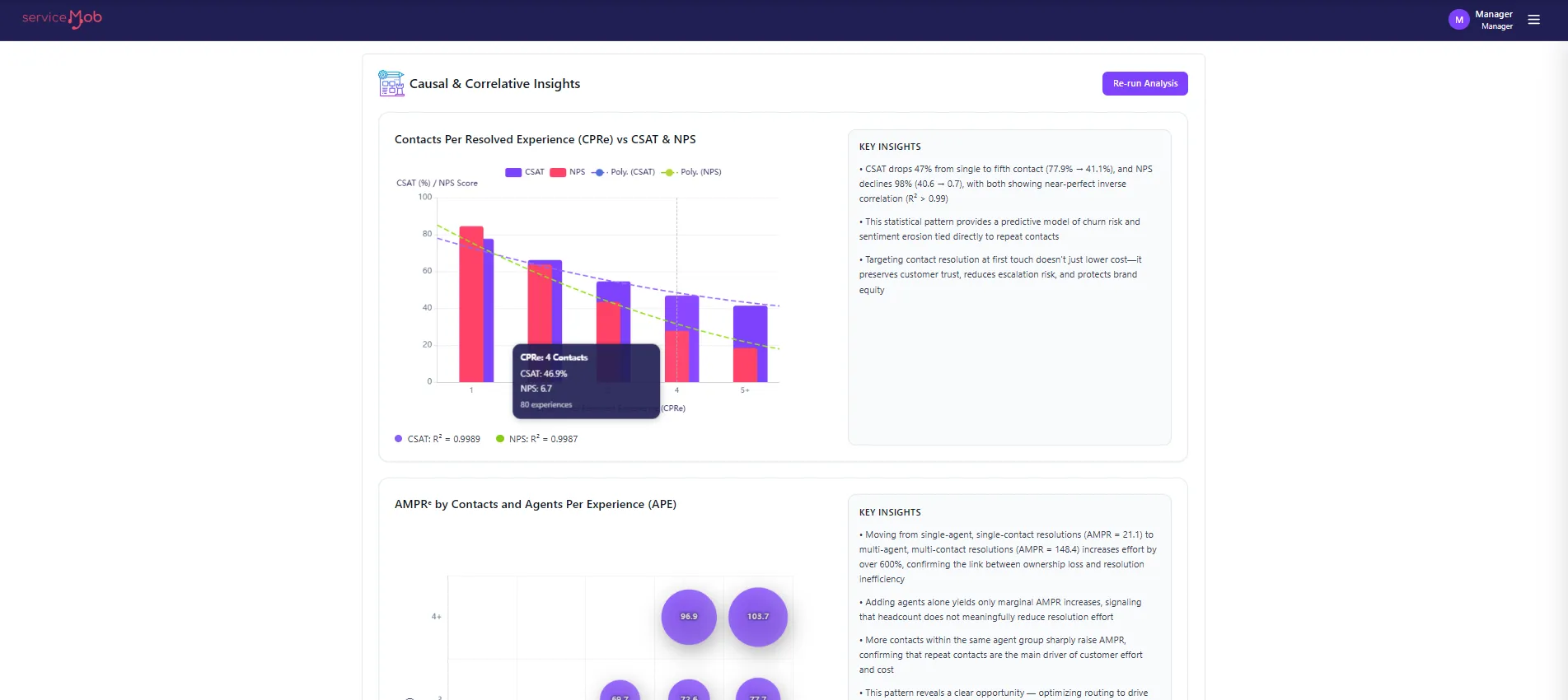
A data ontology is a prescriptive framework that models the customer experience as structured data. It transforms every service and support signal, interactions, contacts, cases, transcripts, tickets, surveys, automated QA, chatbot and voice-agent sessions, sentiment, plus enterprise data, into measurable inputs that connect strategy to outcomes.
The Data Ontology and the Large Ontology Model together are the Brain for service and support. Each client receives an ontology mapped to their industry and business segments across three dimensions: point of view, channel and phase. Pick a POV, a channel and a phase, and it should map to a source system. Where it does not, the NULL is the finding.
The Brain enables the Answer Engine: the signal layer that surfaces the most painful and most prevalent experiences, with R-squared correlations that carry through to the outcomes you run the business on: gross margin, churn and cost to serve.
Questions
The two questions we hear first.
What is the Brain for Customer Service & Support?
serviceMob's Experiential Answer Engine. It models every customer's experience as one connected record across channels, teams and time, computes the metrics that predict satisfaction and demand, and answers questions about them in plain language through mobAI. mobAI is the ask-questions-get-clarity interface for managers and executives, never a contact-handling bot.
How is the Brain priced?
Per active agent per month. One fee covers the platform and the Forward Deployed team that builds and runs your ontology. The figure is in your proposal.
The experience point of view
Three calls, three agents, one issue. The dashboard saw three good contacts.
-
Problem
A customer contacts support three times in one week about a single issue and speaks with three different agents. The calls run 7 minutes 10 seconds, 8 minutes 23 seconds and 4 minutes 45 seconds. The operations dashboard reports an average handle time of 6 minutes 46 seconds and a CSAT of 80%.
-
Complication
Every tool in the stack logged its own output: a contact, a transcript, a case, a survey. None of them is set up to model the experience those outputs add up to. Handle time tracks satisfaction at R² 0.0699. It explains 7% of it.
-
Solution
The Brain models the same week from the customer's point of view: one experience, 20 minutes 18 seconds of effort (AMPRx), 3 contacts (CPRx), 3 agents (APRx), 7 days to resolution (DTRx), issue type ranked first by churn. Then it tags the issue to the business unit that caused it.
-
Value
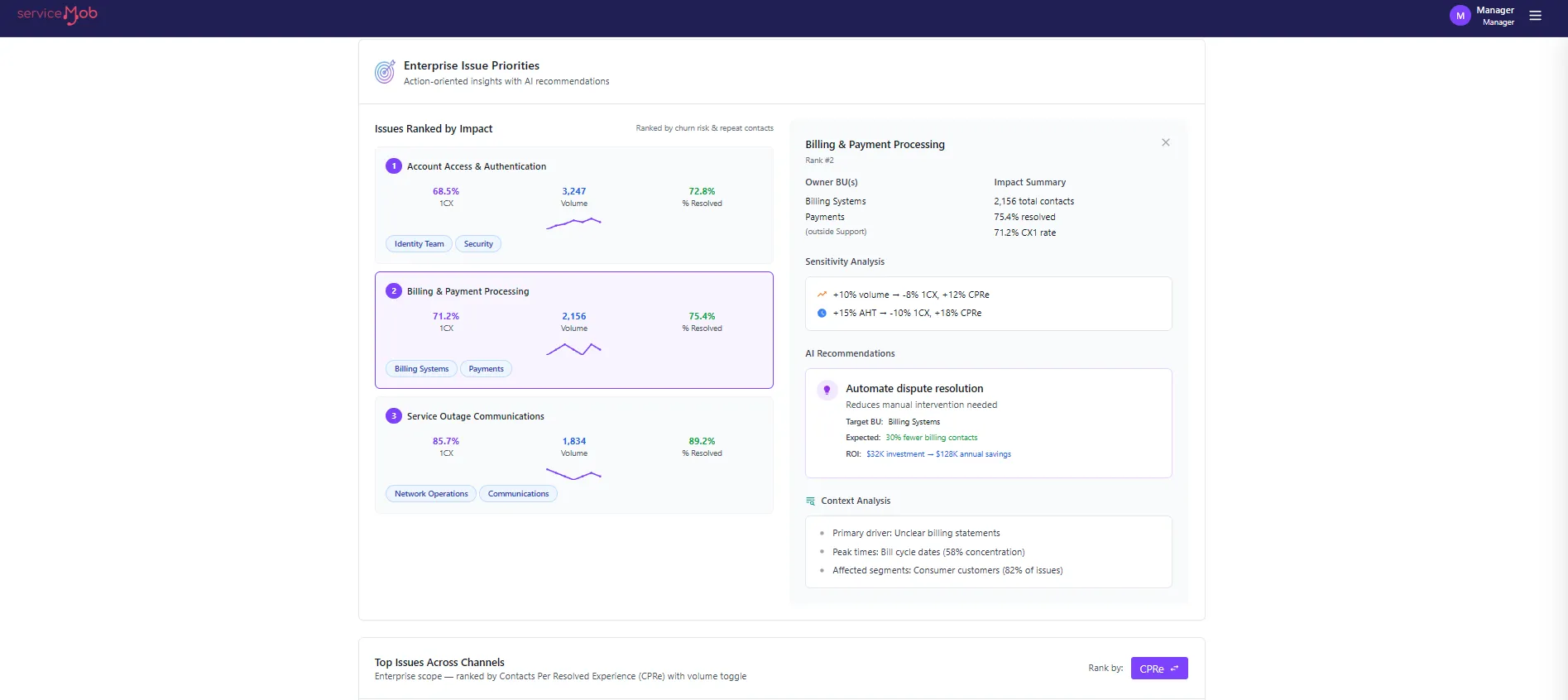
Contacts per resolved experience is the demand multiplier. NPS falls from 54.2 at one contact to 22.2 at five or more (R² 0.998); CSAT falls from 83.9 to 58.2 (R² 0.985). Reduce the contacts it takes to resolve, and demand, cost to serve and churn move together. Measured on 100% of behavioral data, every contact.
The correlation
Satisfaction falls with every extra contact.
Contacts per resolved experience against NPS and CSAT, measured across all experiences on one enterprise program. The relationship is linear and it is steep.
-
54.2 to 22.2
NPS, from one contact to five or more
Linear fit, R² 0.998
-
83.9 to 58.2
CSAT, from one contact to five or more
Linear fit, R² 0.985
-
R² 0.981
AMPRx to CSAT and NPS
Average Minutes Per Resolved Experience
The Answer Engine
Three altitudes. One model underneath.
Frontline observability for operations: which agents are struggling to resolve, which teams, site by site and agent by agent, with the detail to prevent the repeat.
Agentic Performance Management: every agent coached on effort metrics, human specialists and AI agents on one scale.
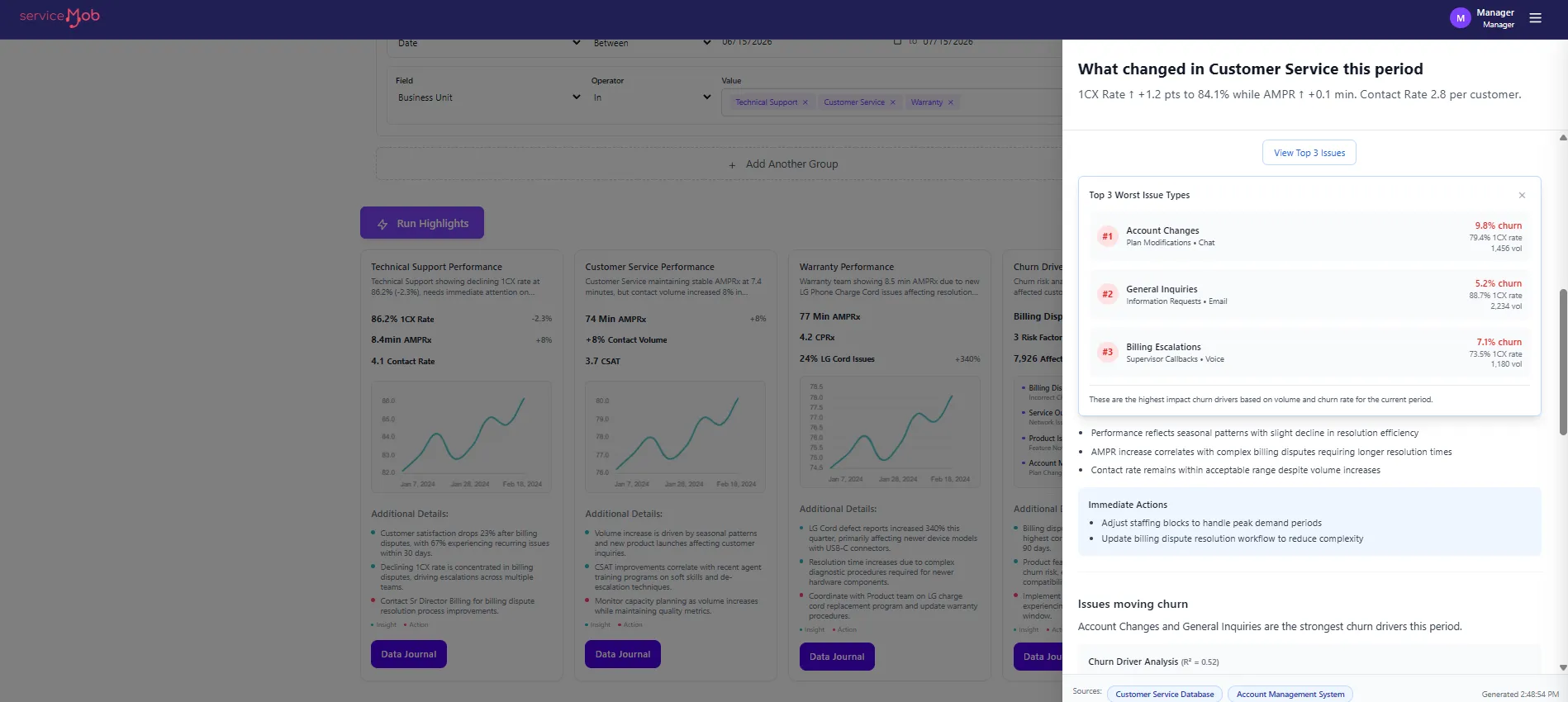
The executive layer: Data Journals record what changed this period, where and why, per business unit. mobAI answers the questions leaders ask of the data, with drill-downs to the agent and issue level, so the business units causing demand know exactly what to change to prevent it.
How we deliver
The people ship with the software.
The Brain arrives as Software with a Service: the platform plus a Forward Deployed team that builds your ontology, runs the program and stays as your systems change. One fee covers both. Pricing is set in your proposal.
-
FDE
Forward Deployed Engineers
Build and validate the data ontology, normalize fragmented data and establish secure pipelines.
-
FDS
Forward Deployed Strategists
Advisory, roadmaps, operating model design and the recommendations that move the business units causing demand.
-
FDDS
Forward Deployed Data Scientists
Predictive models, experiential analytics and the statistical validation behind every number we publish.
-
SME
Subject Matter Experts
Contact center, CRM, workforce management and industry depth, inside your operation from the first week.
How many customer experiences did you have last week?
If the answer is a count of tickets, the experience is not modeled yet. A working session shows what the Brain would build first from the data you already have.