
Product: workforce
Your whole workforce management function. Run for you.
WFMaaS forecasts contact demand from the business signals that create it, then builds and publishes the schedules, manages the intraday and optimizes vendors and sites. Your team never touches a scheduler.
-
97 to 98%
forecast accuracy, where typical WFM tools reach 85 to 90%
-
15-minute
forecast interval, the resolution where service breaks
-
13
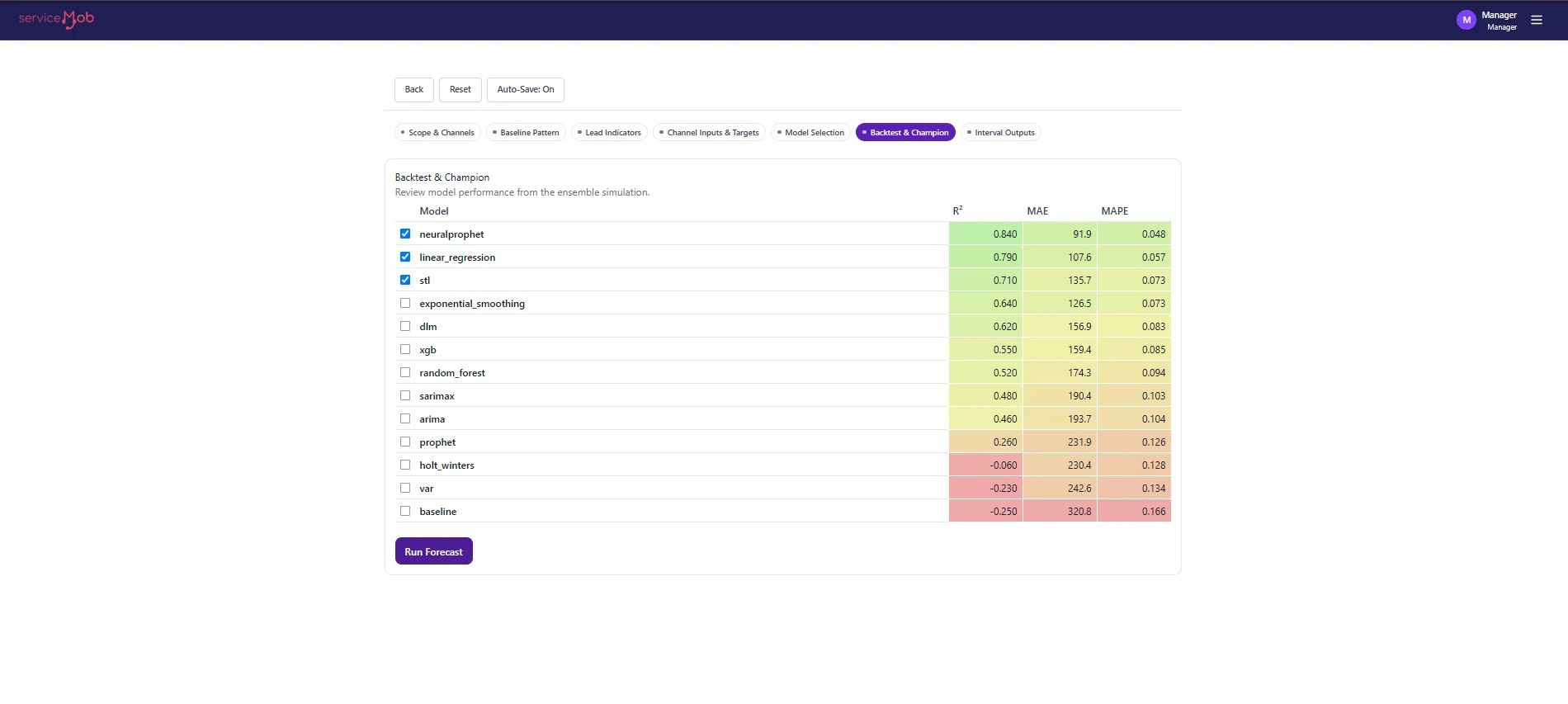
models in the ensemble, back-tested with MAPE and R² every cycle
Definition
What WFMaaS is.
WFMaaS delivers the entire workforce management function as a service: forecasting, scheduling, real-time adherence, intraday management and vendor and capacity optimization, with nothing for your team to build, license or run. serviceMob becomes your dedicated WFM team.
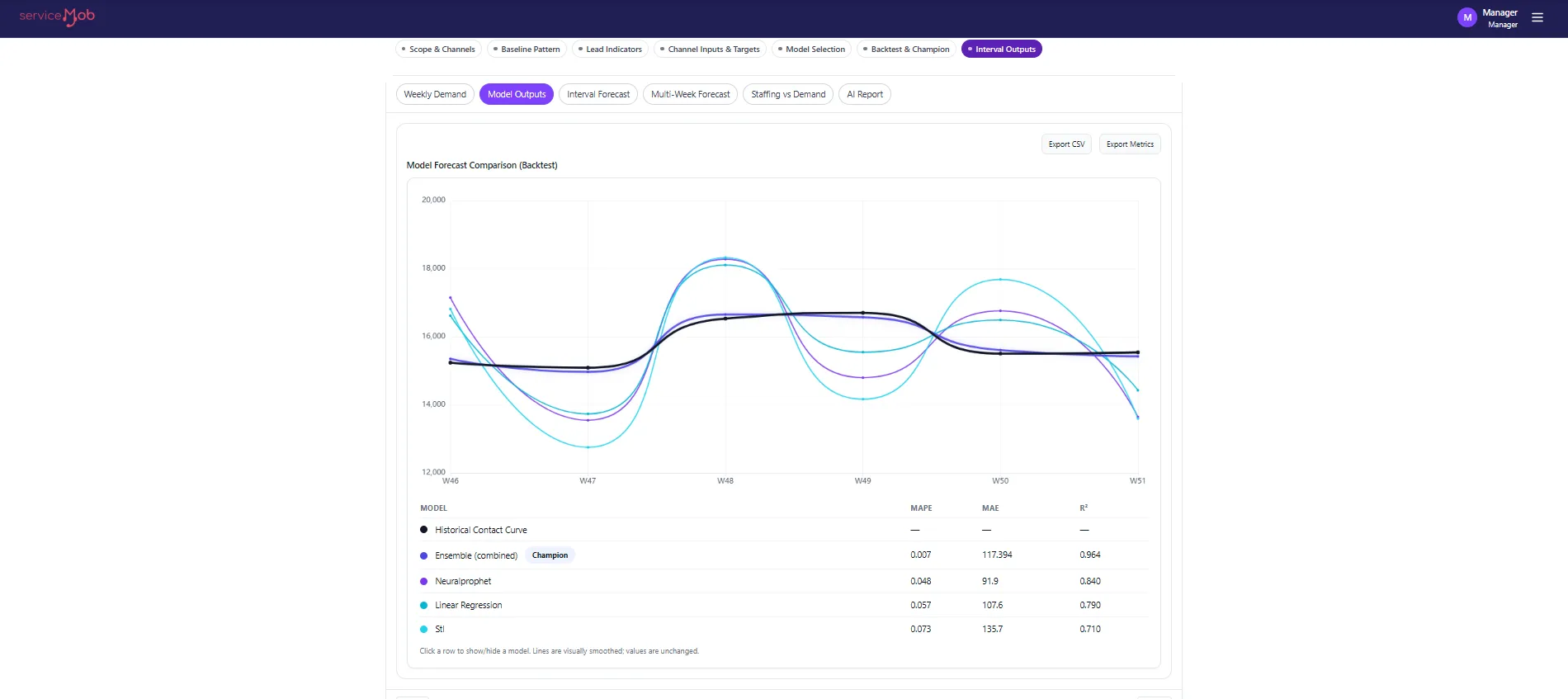
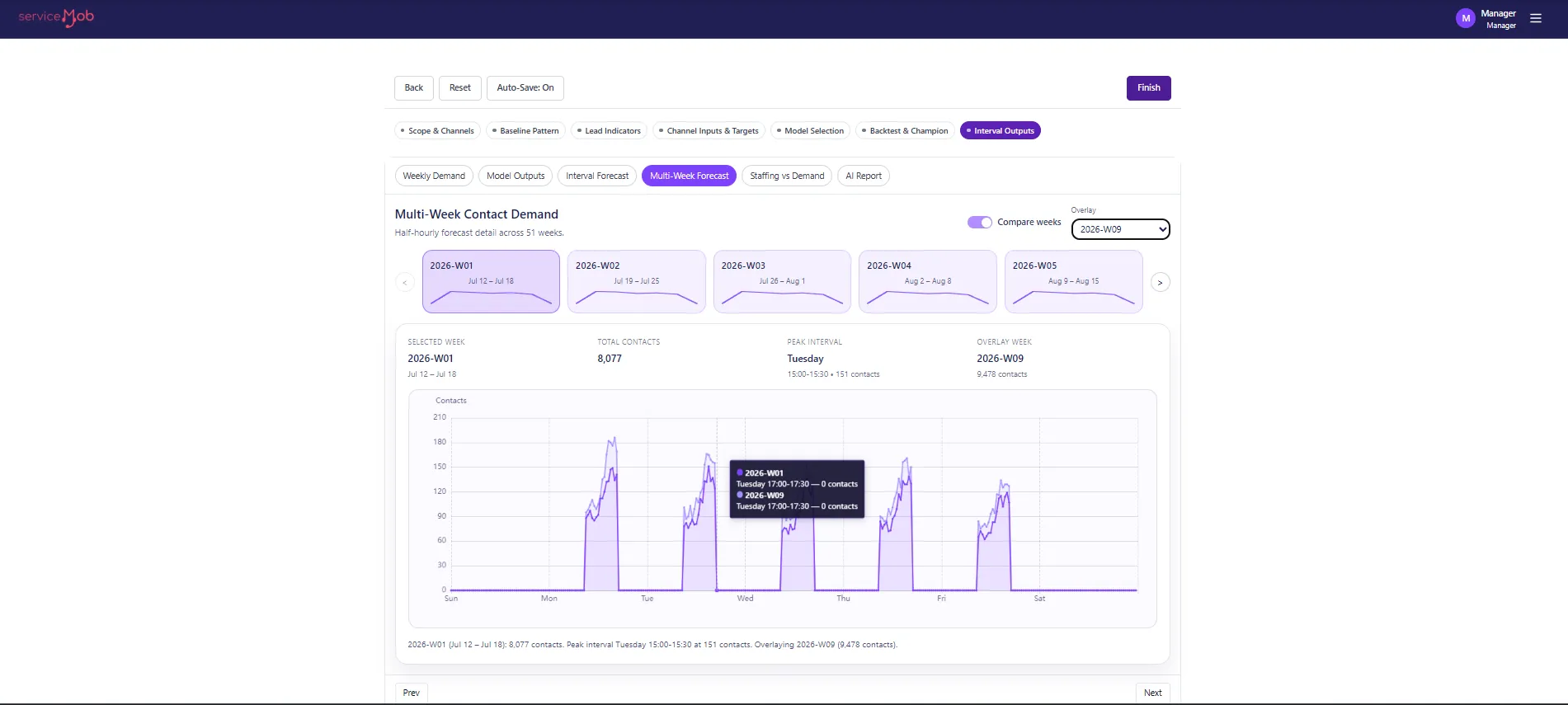
Inside it runs Forecasting as a Service (FaaS): experiential forecasting at 15-minute intervals that models contact demand from the external business drivers legacy WFM ignores, includes the repeat behavior legacy models cannot see, and validates every forecast with MAPE and R-squared. Forecasts perform within plus or minus 3% of actual demand curvature, 97 to 98% accuracy where the industry standard is 85 to 90%.
Questions
The two questions we hear first.
What is WFMaaS?
Workforce Management as a Service. Every forecast, every schedule and every intraday move, built and run by serviceMob on experiential forecasts, across voice, chat, messaging, SMS and email. No modules, no add-on tiers to decode.
How is it priced?
Per FTE per month, all-inclusive, with an implementation fee per business unit and monthly hosting. It scales with seats, so you can start with one business unit. The figures are in your proposal.
The forecast is wrong at the source
The WFM director had a forecast for every interval and no idea what drove any of them.
-
Problem
A workforce management director runs forecasts on historical contact volume with rolling averages and Erlang-C, then builds schedules, shift bids and intraday decisions on top of them. Most enterprises retain 15 to 30% more staff than necessary as a result, or understaff and fail customers, and carry a full internal WFM team as fixed headcount either way.
-
Complication
The data feeding the forecast is incomplete, inconsistent and inaccurate. WFM software takes no inputs on what drives demand, does not know the repeat contact rate, and rarely back-tests with MAPE or R-squared. 99% of WFM teams never receive the inputs they would need. Gartner, McKinsey and Deloitte each describe the same limits: historical patterns, simple queueing models, no upstream signals.
-
Solution
Contact demand is a derivative of your business. WFMaaS ingests the external signals that create it and models traffic directly from them: daily active users in gaming, booked nights in hospitality, subscriber cohorts and billing cycles in subscription, revenue and order volume in commerce. It forecasts at 15-minute intervals, validates every cycle statistically, then builds and publishes the schedules and manages the day.
-
Value
A healthcare unicorn with member and provider support queues and about 25,000 contacts a month reached 98.3% forecast accuracy at a 15-minute interval, deflected $7.3M in cost, reduced the need for 110 FTE, improved occupancy by 30% and cut abandonment by 70%.
Healthcare Unicorn
One member-services operation, before and after.
Member and provider support call queues, about 25,000 contacts a month. Before: no way to know how many agents were needed to deliver a positive experience, occupancy at 30%, abandonment at 70%.
-
98.3%
forecast accuracy
At a 15-minute interval
-
$7.3M
cost deflection
-
110
FTE reduction
-
30%
occupancy improvement
-
70%
abandonment rate reduction
The core differentiator
Contact demand is a derivative of your business.
Legacy WFM forecasts from the contact center's own history. WFMaaS forecasts from the units your business grows in, and it works in both directions: when the driver falls, the forecast sheds staffing cost before the quiet weeks arrive.
- Experiential forecasting at 15-minute intervals, with repeat behavior in the model.
- External-signal demand models: your business drivers as live forecast inputs.
- Full scheduling, done for you: long-range, weekly and intraday plans built, optimized and published.
- Intraday management: live re-forecasts and same-day moves as demand arrives.
- Vendor and capacity optimization across sites and BPOs.
- Statistical validation every cycle: MAPE and R-squared on every forecast.
How we deliver
The people ship with the software.
WFMaaS is a service by definition: serviceMob's Forward Deployed team forecasts, schedules and manages the intraday for you, on the platform, and stays as your channels and vendors change. Pricing is set in your proposal.
-
FDE
Forward Deployed Engineers
Connect the demand drivers and the contact data, normalize what is fragmented and establish secure pipelines.
-
FDS
Forward Deployed Strategists
Operating model design, vendor accountability and the staffing decisions the forecast makes possible.
-
FDDS
Forward Deployed Data Scientists
The ensemble models, the back-tests and the MAPE and R-squared validation on every forecast.
-
SME
Subject Matter Experts
Workforce management, contact center and industry depth, running your intraday from the first week.
Forecast the business. Staff the experience.
Bring your current forecast and last quarter's actuals to a working session. We will show the variance and which business signals would have explained it.