
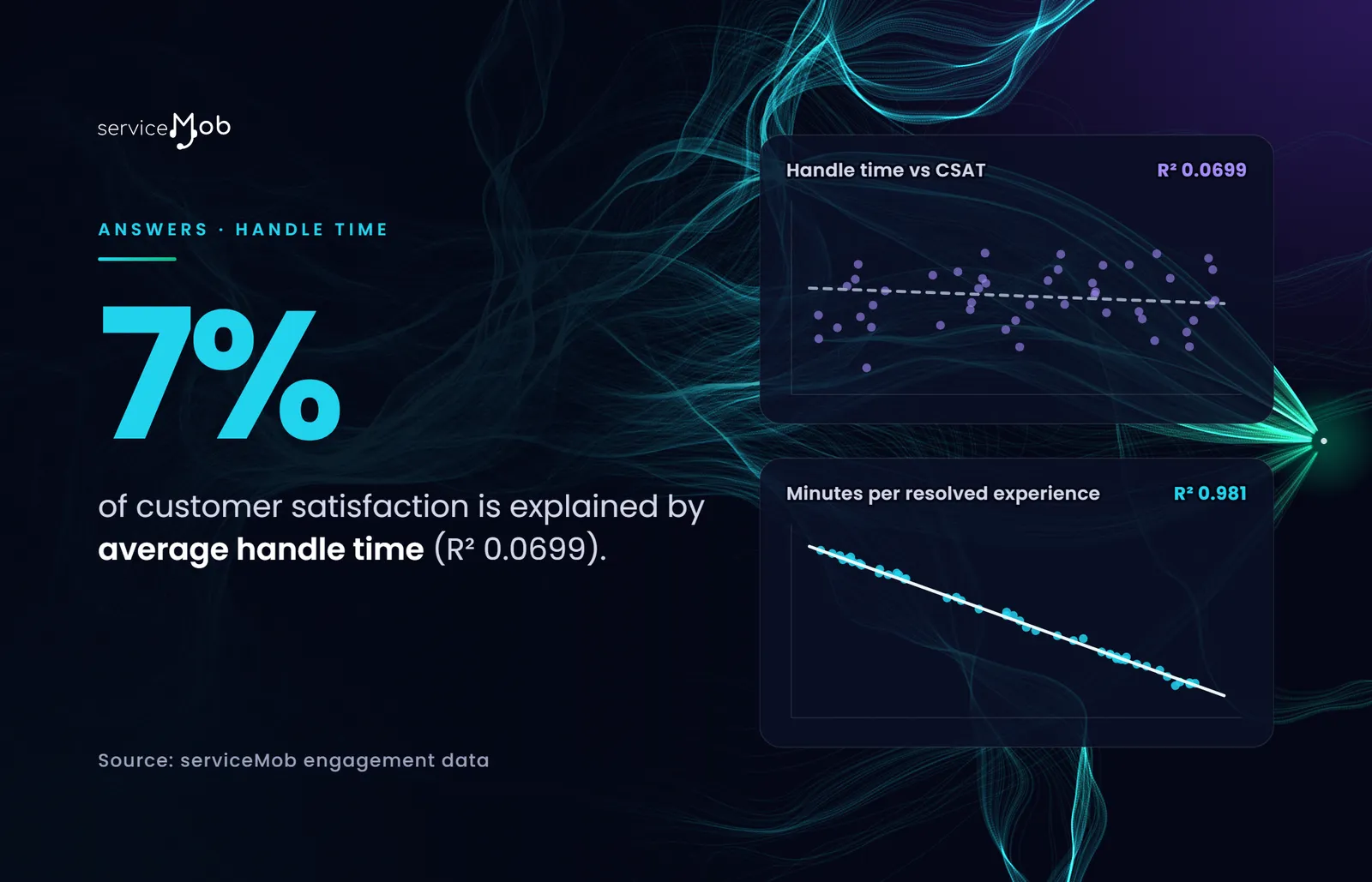
Handle time is the number most contact centers manage to, and it barely moves satisfaction. That surprises people who have spent years pushing it down. It shouldn’t. Handle time answers a question the customer never asks.
How weak is the link between handle time and satisfaction?
In serviceMob engagement data, Average Handle Time tracks CSAT at R² 0.0699: line handle time up against satisfaction and it accounts for 7% of the variation. That is too weak a link to expect a lower AHT to move CSAT. Whatever drives the rest, it isn’t how long the call took.
Run the same comparison with AMPRx, Average Minutes Per Resolved Experience, and the picture flips. AMPRx is the total minutes of effort it takes to resolve a customer’s experience, counted across every contact that experience generated, on every channel, until the issue is truly resolved. In the same data it tracks CSAT and NPS at R² 0.981.
Both metrics count minutes. What they count minutes of is different. AHT counts the minutes inside one contact. AMPRx counts the minutes the customer spent getting the problem fixed.
Why does handle time miss what customers care about?
Handle time misses what customers care about because it measures a contact, and customers judge the experience. Nobody hangs up and rates a call on its duration. They rate whether the problem went away and how much work it took them to get there.
Take a customer moving to a cheaper plan. She calls, the agent is quick and polite, and the call ends fast with a promise that the change will show on her next statement. It doesn’t. She calls back a few days later, explains everything again to a new agent, and gets transferred to the accounts team.
On the operations dashboard that is two short calls and a transfer, each inside target. For the customer it is one problem, most of a week, and the same story told three times.
Handle time can’t see any of that. It doesn’t know the second call was about the same plan change. It doesn’t count the days between contacts, which is what DTRx, Days To Resolved Experience, measures. And it gives the fast first call full credit for a resolution that never happened.
What happens when a contact center pushes AHT down?
Under AHT pressure, agents find the fastest way to end a call, and often that is not the way that resolves it. A transfer ends the call. So does a promised callback, a link to a help article, or fixing the symptom and leaving the cause. Each one takes minutes off the agent’s clock and puts them back on the customer’s.
Those minutes return as repeat contacts. In North American inbound call centers, 29% of customers have to call back about the same issue (SQM Group, 2022), and a program that rewards short calls gives agents a reason to add to that share.
So an AHT program can work exactly as designed and still fail. Calls get shorter and the dashboard turns green while satisfaction slides, because the same customers are calling more often. Cost doesn’t improve either. Two short calls about one issue can easily cost more than one call that fixed it.
What should you measure instead of AHT?
The resolved experience is the better unit: how much effort it took, how many contacts, how many days, and whether the customer had to come back. AMPRx covers the effort and is the one that tracks satisfaction. CPRx, Contacts Per Resolved Experience, counts the contacts, inbound and outbound, and every contact after the first is demand that should not exist. DTRx counts the days. 1CX Rate, One-Contact Experience Rate, is the share of experiences resolved with no additional contact, observed in what the customer did next and never from ticket closure.
If transfers are your problem, add APRx, Agents Per Resolved Experience. Every extra agent is the customer telling the story again. Each of these maps to a signal most teams already watch, such as transfers or channel switches, and the customer effort mapping goes through them one by one.
None of these can be computed from a contact log as it stands. A ticketing system records contacts. It has no idea that Tuesday’s chat and Friday’s call were the same problem. Joining contacts into experiences is the real work, and it is what serviceMob’s Brain does: it models each customer’s experience as one connected record across channels, teams and time, so the metrics run on every experience instead of a sample.
Should you stop tracking handle time?
No. Keep handle time for workforce planning and stop using it to judge agents or the customer experience. Forecasting and staffing need minutes per contact, and AHT is the right input there. The damage starts when it becomes an agent target, because then it rewards the short call over the resolved one.
The better coaching target is the outcome. In Agentic Performance Management, every agent, human or AI, is measured on 1CX Rate, CPRx and AMPRx by issue type and compared with peers and the floor. The coaching question changes from “why was your call long?” to “which issue types come back after you handle them, and what do the agents who resolve them say differently?”
The same logic settles the argument about AI agents. A bot that ends conversations quickly has a great handle time. Whether it resolved anything shows up in CPRx, when the same customer reaches a human a few days later.
How do you test this in your own operation?
The test needs two correlations from your own data. Take the customers who answered a satisfaction survey. For each one, find the handle time of the surveyed contact, then the total minutes across every contact about the same issue. Plot each against the score.
The hard part is the second number, because it requires knowing which contacts belong to the same issue across channels. That difficulty is also why handle time became the default. It is the one effort number the phone system hands you without joining anything.
Questions
What is a good average handle time?
There isn't one worth targeting. Handle time varies by issue type and channel, and a short call that leaves the issue open is worse for the customer and usually comes back as another contact. Set expected handle time by issue type for staffing forecasts, and judge quality on whether the experience resolved.
Does a longer call mean a happier customer?
No. Call length explains little of satisfaction in either direction: in serviceMob engagement data, handle time tracks CSAT at R² 0.0699. What matters is whether the call resolved the issue. A long call that fixes the problem beats two short calls that don't.
How is AMPRx different from AHT?
AHT averages the minutes of single contacts. AMPRx adds up the minutes of every contact, on every channel, that one customer experience needed before it was resolved, and averages that per resolved experience. A fast call that leads to a callback lowers AHT and raises AMPRx.
Is first contact resolution a better metric than AHT?
It is closer, because it asks whether the issue was resolved. In SQM Group's benchmark of North American inbound call centers, every 1% improvement in first call resolution brings a 1% improvement in customer satisfaction. Ticket-based FCR trusts closure, though, and misses the customer who comes back on another channel. 1CX Rate is observed from what the customer did next, and BD-FCR counts the outbound follow-ups FCR ignores.