
Ask a service team whether it fixes issues the first time and you get a percentage, often a flattering one. Ask a customer and the answer depends on how many times they had to get in touch. First contact resolution exists to close that gap. Counted the way most operations count it, it hides the gap.
What is wrong with first contact resolution as usually measured?
The trouble is where the verdict comes from. FCR needs a yes or no for each contact, and most operations take it from the nearest record to hand: a case status, an agent’s wrap-up code or a survey answer given minutes after the call. Every one of those records sits in a single channel and is written the moment the contact ends.
Gartner (2024) found that most customer service leaders “think they’re measuring FCR but only capture channel-specific issue resolution.” For customers, the first contact is their first attempt to resolve the issue, in any channel.
In practice, a phone queue can post a strong FCR for customers who had already spent a morning in the help center and a chat window before they dialed. The phone team sees one call. The customer sees a third attempt.
How much does the usual FCR number miss?
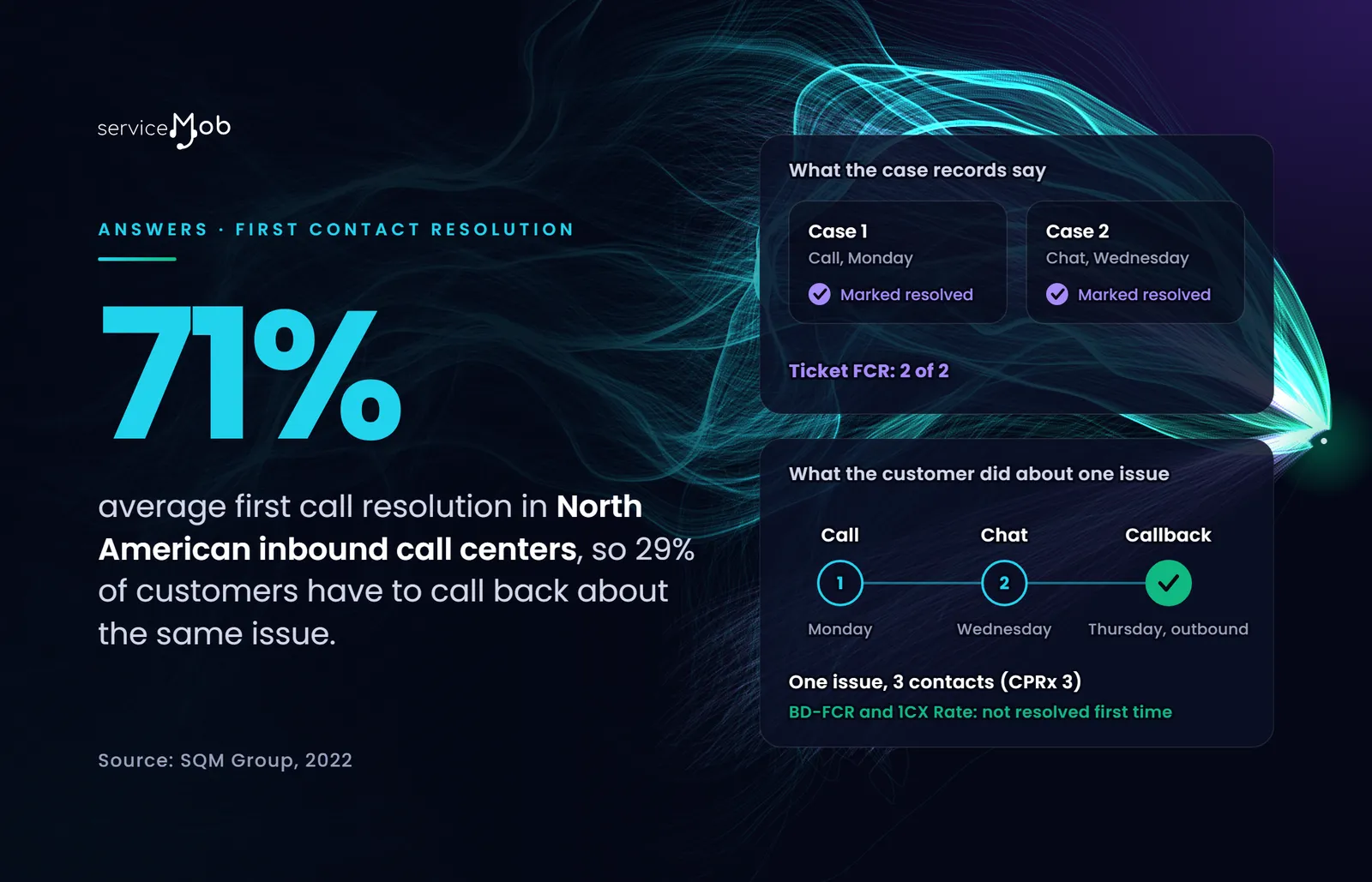
Even on the phone alone, many customers come back. SQM Group’s 2022 benchmark of North American inbound call centers puts average first call resolution at 71%, so 29% of customers have to call back about the same issue (SQM Group, 2022).
That benchmark comes from post-call surveys of callers, so it describes the phone and nothing else. An email sent the next day about the same issue never reaches it, and neither does an agent’s follow-up call to confirm a fix. Most operations cannot size what sits outside, because each channel keeps its records in its own system.
Should resolution stay on the scorecard?
Yes. Resolution is what the customer got in touch for. In SQM Group’s benchmark of North American inbound call centers, every 1% improvement in first call resolution brings a 1% improvement in customer satisfaction. That is a relationship in benchmark data, not proof that one causes the other. It argues for counting resolution from the customer’s side, across every channel the issue touched.
What should replace first contact resolution?
Two measures, both read from what the customer did next.
BD-FCR, Bi-Directional First Contact Resolution, adds the outbound side. When an agent picks up the phone to confirm a refund or complete a fix, that call means the issue was not resolved on first contact, whatever the case status says. BD-FCR also sees a customer who returned through another channel.
1CX Rate, the One-Contact Experience Rate, counts the experiences that ended without the customer needing another contact, as a share of all of them. It is observed in the customer’s later behavior, on every channel, and never taken from ticket closure. It is the number to coach agents to.
Behind both sits CPRx, Contacts Per Resolved Experience, which shows how many attempts the failed experiences took.
Take one billing error as an example. On Monday the customer calls, and the agent promises a credit and closes the case. On Wednesday the credit has not appeared, so the customer opens a chat, which creates a second case, also closed on contact. On Thursday an agent calls out to confirm the credit posted. Ticket-based FCR records two cases, both resolved first time. BD-FCR and 1CX Rate record one issue that was not resolved on first contact, with a CPRx of 3.
How do you measure BD-FCR and 1CX Rate?
Start with one record per customer issue. Link every contact about that issue to the customer and to the reason for the contact, covering phone, chat, email, messaging and bot sessions, inbound and outbound. Then read forward from each contact. Did the customer come back about the same thing? Did someone have to call them? Did the issue stay fixed?
Linking is where the effort goes. Channels rarely share a customer key, and the case a chat opens is seldom tied to the call that came before it. Until those records are joined, every resolution rate is a per-channel estimate.
Should you stop reporting FCR?
Not on day one. Run ticket-based FCR and 1CX Rate side by side for a quarter. The distance between them is the resolution your current number claims and customers did not get, broken down by issue type and team. Where a failing issue type traces back to billing, logistics or product, take the gap to that team with the customers it touched.
Then move the targets. An agent scored on ticket FCR learns to close cases. An agent coached on 1CX Rate, issue type by issue type, learns which answers hold. Agentic Performance Management coaches human and AI agents to 1CX Rate this way. Experiences that fail also cost customers, which the churn metrics answer follows through to retention.
How do you get started?
Export a month of cases from every channel, add the outbound call log, and link the contacts that belong to the same customer and issue. Count how many issues closed on first contact came back. That share is your first FCR number measured from the customer’s side.
serviceMob does that linking in the Experiential Answer Engine for Service & Support, the Brain, which keeps each customer experience as one record across channels and teams and computes BD-FCR and 1CX Rate on it. A Forward Deployed team runs the setup inside your operation. Book a Working Session to see the gap between your ticket FCR and your 1CX Rate.
Questions
Is first contact resolution the same as first call resolution?
They started as the same idea. First call resolution comes from the phone and counts calls. First contact resolution was meant to cover every channel, but many teams still measure it inside one channel at a time. SQM Group's benchmark figures are first call resolution, for North American inbound call centers.
How is BD-FCR different from 1CX Rate?
BD-FCR keeps the shape of a first contact resolution rate and adds the outbound follow-ups, so an issue an agent had to finish with a callback is not credited as resolved on first contact. 1CX Rate starts from the experience: the share of customer issues that needed no further contact of any kind, judged by what the customer did afterward. Report BD-FCR where you need continuity with old FCR reports, and coach to 1CX Rate.
Can a post-call survey measure first contact resolution?
It measures what the customer believed when the call ended. A customer told that a refund is on its way answers yes, and finds out a week later whether it arrived. Surveys also hear only from the customers who reply. Keep them as a check, and take resolution from the customer's next move.
How can you tell whether an FCR rate is good?
Check it against what customers did afterward. Take the issues marked resolved on first contact and count how many came back within a fixed window, on any channel, including follow-up calls your agents made. Put that beside the reported FCR. 1CX Rate makes the check routine, since it is the share of experiences that needed no further contact. A high FCR next to many returns means the rate is counting closures.